SINGLE PHASE TRANSFORMER POLARITY BASICS AND TUTORIALS

POLARITY OF SINGLE PHASE TRANSFORMERS BASIC INFORMATION
How To Know The Polarity Of Single Phase Transformers?


Single-Phase Polarity
The polarity of a transformer can either be additive or subtractive. These terms describe the voltage that may appear on adjacent terminals if the remaining terminals are jumpered together.

The origin of the polarity concept is obscure, but apparently, early transformers having lower primary voltages and smaller kVA sizes were first built with additive polarity. When the range of kVAs and voltages was extended, a decision was made to switch to subtractive polarity so that voltages between adjacent bushings could never be higher than the primary voltage already present.

Thus the transformers built to ANSI standards today are additive if the voltage is 8660 or below and the kVA is 200 or less; otherwise they are subtractive.

This differentiation is strictly a U.S. phenomenon. Distribution transformers built to Canadian standards are all additive, and those built to Mexican standards are all subtractive. Although the technical definition of polarity involves the relative position of primary and secondary bushings, the position of primary bushings is always the same according to standards.

Therefore, when facing the secondary bushings of an additive transformer, the X1 bushing is located to the right (of X3), while for a subtractive transformer, X1 is farthest to the left.

To complicate this definition, a single-phase pad-mounted transformer built to ANSI standard Type 2 will always have the X2 mid-tap bushing on the lowest right-hand side of the lowvoltage slant pattern.

Polarity has nothing to do with the internal construction of the transformer windings but only with the routing of leads to the bushings. Polarity only becomes important when transformers are being paralleled or banked. Single-phase polarity is illustrated in Figure 2.2.11.
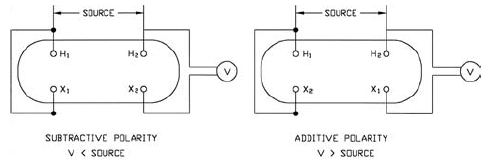

FIGURE 2.2.11 Single-phase polarity. (Adapted from IEEE C57.12.90-1999. The IEEE disclaims any responsibility or liability resulting from the placement and use in the described manner.

FERRORESONANCE AND DISTRIBUTION TRANSFORMER CONTRIBUTION BASICS AND TUTORIALS

FERRORESONANCE AND DISTRIBUTION TRANSFORMER CONTRIBUTION BASIC INFORMATION
What Is The Contribution Of Distribution Transformers On Ferroresonance?

Ferroresonance is an overvoltage phenomenon that occurs when charging current for a long underground cable or other capacitive reactance saturates the core of a transformer.

Such a resonance can result in voltages as high as five times the rated system voltage, damaging lightning arresters and other equipment and possibly even the transformer itself.

When ferroresonance is occurring, the transformer is likely to produce loud squeals and groans, and the noise has been likened to the sound of steel roofing being dragged across a concrete surface.

A typical ferroresonance situation is shown in Figure 2.2.10 and consists of long underground cables feeding a transformer with a delta-connected primary.


FIGURE 2.2.10 is a typical ferroresonance situation. (From IEEE C57.105-1978, IEEE Guide for Application of Transformer Connections in Three-Phase Distribution Systems, copyright 1978 by the Institute of Electrical and Electronics Engineers, Inc. The IEEE disclaims any responsibility or liability resulting from the placement and use in the described manner. Information is reprinted with the permission of the IEEE.)


The transformer is unloaded or very lightly loaded and switching or fusing for the circuit operates one phase at a time.

Ferroresonance can occur when energizing the transformer as the first switch is closed, or it can occur if one or more distant fuses open and the load is very light. Ferroresonance is more likely to occur on systems with higher primary voltage and has been observed even when there is no cable present.

All of the contributing factors — delta or wye connection, cable length, voltage, load, single-phase switching —must be considered together. Attempts to set precise limits for prevention of the phenomenon have been frustrating.

For more on ferroresonance click the link.

Previous Articles