THREE PHASE TRANSFORMER POLARITY EFFECTS AND STANDARD ANGULAR DISPLACEMENT BASIC INFORMATION
Polarity Effects And Standard Angular Displacement Of Three Phase Transformers
Polarity Effects
Any combination of additive and subtractive units can be connected in three-phase banks so long as the correct polarity relationship of terminals is observed.
Whether a transformer is additive or subtractive does not alter the designation of the terminals (X1, X2, etc.) thus correct polarity will be assured if connections are made as indicated in the diagrams.
The terminal designations, if not marked, can be obtained from the transformer nameplate which shows the schematic internal-connection diagrams diagramming the actual physical relationship between the high and low voltage terminals.
If subtractive-polarity transformers are used in threephase banks secondary connections are simplified from those shown for the additive-polarity units.
The additivepolarity connections, for standard angular isplacement, are somewhat complicated, particularly in cases with delta-connected secondary, by the crossed secondary interconnections between units.
For this reason simplified bank connections, which give non-standard angular displacement between primary and secondary systems, are sometimes used with additive-polarity units.
Standard Angular Displacement
Standard angular displacement or vector relationships between the primary and secondary voltage systems, as defined by ANSI publications, are 0° for delta-delta or wye-wye connected banks and 30° for delta-wye or wye-delta banks.
Angular displacement becomes important when two or more three-phase banks are interconnected into the same secondary system or when three-phase banks are paralleled. In such cases it is necessary that all of the three-phase banks have the same displacement.
The following diagrams cover three-phase circuits using:
1. Standard connections—where all units have additive polarity and give standard angular displacement or vector relation between the primary and secondary voltage systems (as defined by ANSI publications).
2. Simplified connections for the more common three phase connections with the delta-connected secondary— where all units have additive polarity but give nonstandard angular displacement between the primary and secondary voltage system.
Showing posts with label Polarity. Show all posts
Showing posts with label Polarity. Show all posts

POLARITY TEST OF SINGLE PHASE TRANSFORMER BASIC AND TUTORIALS
SINGLE PHASE TRANSFORMER POLARITY TESTS BASIC INFORMATION
What Are The Polarity Tests Of Single Phase Transformers?
Polarity tests on single-phase transformers shall be made in
accordance with one of the following methods:
a) Inductive kick
b) Alternating voltage
c) Comparison
d) Ratio bridge
Polarity by inductive kick
The polarity of transformers with leads arranged as shown in
may be determined when making resistance measurements as follows:
a) With direct current passing through the high-voltage
winding, connect a high-voltage direct-current voltmeter across the
high-voltage winding terminals to obtain a small deflection of the pointer.
b) Transfer the two voltmeter leads directly across the
transformer to the adjacent low-voltage leads, respectively.
NOTE—For example, in Figure 5, the voltmeter lead connected
to H1 will be transferred to X2 as the adjacent lead,and that connected to H2to
X1.

c) Break direct-current excitation, thereby inducing a
voltage in the low-voltage winding (inductive kick), which will cause
deflection in the voltmeter. The deflection is interpreted in d) and e) below.
d) When the pointer swings in the opposite direction
(negative), the polarity is subtractive.
e) When the pointer swings in the same direction as before
(positive), the polarity is additive.
Polarity by alternating-voltage test
For transformers having a ratio of transformation of 30 to 1
or less, the H1 lead shall be connected to the adjacent low-voltage lead (X1 in
Figure 6).

Any convenient value of alternating voltage shall be applied
to the full high-voltage winding and readings taken of the applied voltage and
the voltage between the right-hand adjacent high-voltage and low-voltage leads.
When the latter reading is greater than the former, the
polarity is additive. When the latter voltage reading is less than the former
(indicating the approximate difference in voltage between the high-voltage and
low-voltage windings), the polarity is subtractive.
Polarity by comparison
When a transformer of known polarity and of the same ratio
as the unit under test is available, the polarity can be checked by comparison,
as follows, similar to the comparison method used for the ratio test.
a) Connect the high-voltage windings of both transformers in
parallel by connecting similarly marked
leads together.
b) Connect the low-voltage leads, X2, of both transformers
together, leaving the X1 leads free.
c) With these connections, apply a reduced value of voltage
to the high-voltage windings and measure the voltage between the two free
leads.
A zero or negligible reading of the voltmeter will indicate
that the relative polarities of both transformers are identical.
An alternative method of checking the polarity is to
substitute a low-rated fuse or suitable lamps for the voltmeter. This procedure
is recommended as a precautionary measure before connecting the voltmeter.
Polarity by ratio bridge
The ratio bridge can also
be used to test polarity. A bridge using the basic circuit below may be used to
measure ratio.
SINGLE PHASE TRANSFORMER POLARITY BASICS AND TUTORIALS
POLARITY OF SINGLE PHASE TRANSFORMERS BASIC INFORMATION
How To Know The Polarity Of Single Phase Transformers?
Single-Phase Polarity
The polarity of a transformer can either be additive or subtractive. These terms describe the voltage that may appear on adjacent terminals if the remaining terminals are jumpered together.
The origin of the polarity concept is obscure, but apparently, early transformers having lower primary voltages and smaller kVA sizes were first built with additive polarity. When the range of kVAs and voltages was extended, a decision was made to switch to subtractive polarity so that voltages between adjacent bushings could never be higher than the primary voltage already present.
Thus the transformers built to ANSI standards today are additive if the voltage is 8660 or below and the kVA is 200 or less; otherwise they are subtractive.
This differentiation is strictly a U.S. phenomenon. Distribution transformers built to Canadian standards are all additive, and those built to Mexican standards are all subtractive. Although the technical definition of polarity involves the relative position of primary and secondary bushings, the position of primary bushings is always the same according to standards.
Therefore, when facing the secondary bushings of an additive transformer, the X1 bushing is located to the right (of X3), while for a subtractive transformer, X1 is farthest to the left.
To complicate this definition, a single-phase pad-mounted transformer built to ANSI standard Type 2 will always have the X2 mid-tap bushing on the lowest right-hand side of the lowvoltage slant pattern.
Polarity has nothing to do with the internal construction of the transformer windings but only with the routing of leads to the bushings. Polarity only becomes important when transformers are being paralleled or banked. Single-phase polarity is illustrated in Figure 2.2.11.

How To Know The Polarity Of Single Phase Transformers?
Single-Phase Polarity
The polarity of a transformer can either be additive or subtractive. These terms describe the voltage that may appear on adjacent terminals if the remaining terminals are jumpered together.
The origin of the polarity concept is obscure, but apparently, early transformers having lower primary voltages and smaller kVA sizes were first built with additive polarity. When the range of kVAs and voltages was extended, a decision was made to switch to subtractive polarity so that voltages between adjacent bushings could never be higher than the primary voltage already present.
Thus the transformers built to ANSI standards today are additive if the voltage is 8660 or below and the kVA is 200 or less; otherwise they are subtractive.
This differentiation is strictly a U.S. phenomenon. Distribution transformers built to Canadian standards are all additive, and those built to Mexican standards are all subtractive. Although the technical definition of polarity involves the relative position of primary and secondary bushings, the position of primary bushings is always the same according to standards.
Therefore, when facing the secondary bushings of an additive transformer, the X1 bushing is located to the right (of X3), while for a subtractive transformer, X1 is farthest to the left.
To complicate this definition, a single-phase pad-mounted transformer built to ANSI standard Type 2 will always have the X2 mid-tap bushing on the lowest right-hand side of the lowvoltage slant pattern.
Polarity has nothing to do with the internal construction of the transformer windings but only with the routing of leads to the bushings. Polarity only becomes important when transformers are being paralleled or banked. Single-phase polarity is illustrated in Figure 2.2.11.
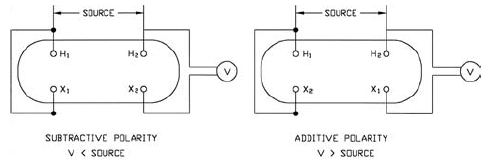
FIGURE 2.2.11 Single-phase polarity. (Adapted from IEEE C57.12.90-1999. The IEEE disclaims any responsibility or liability resulting from the placement and use in the described manner.
Subscribe to:
Posts (Atom)