Showing posts with label Transformer Banking. Show all posts

CONNECTING THREE-PHASE BANKS USING SINGLE-PHASE TRANSFORMERS


There can be advantages to using single-phase transformers to make a three phase bank instead of building a three-phase unit. For instance, it may be impossible or impractical to fabricate or ship a three-phase transformer with an extremely large MVA capacity.

A bank of three single-phase transformers may then be the solution, although the total size, weight, and cost of three single-phase units will probably exceed the size, weight, and cost of one three phase unit.

An additional advantage of the bank arrangement is that a failure of one single-phase unit will usually be less costly to repair than a failure a larger three-phase unit. Furthermore, one spare single-phase transformer is usually all that is required to assure sufficient reliability for the entire bank.

With a three-phase transformer, an additional spare three-phase transformer would be required, so the total cost of the installation plus a spare transformer is twice the cost of the installation alone. The total cost of a bank of single phase transformers plus a spare is only 133% the cost of the bank alone.

Therefore, the total cost of a bank of single-phase transformers plus a spare is probably less than the cost of a three-phase transformer plus a spare.

Either Y or Δ connections are possible with single-phase transformers connected in banks. It is extremely important that the single-phase transformers are carefully matched when they are banked together, especially when the Δ connection is used.

Using mismatched transformers in the Δ connection will result in excessive circulating currents that will severely de-rate the bank or cause overheating.

One interesting configuration for a three-phase bank is the open Y-Δ connection used extensively in rural distribution systems. The open Y-Δ connection uses two single-phase transformers. An open Y-Δ connection requires only two phases plus the neutral on the primary side of the bank in order to develop a three-phase voltage at the secondary.

This is an obvious cost saving (in addition to the avoided cost of a third transformer) when the installation is far away from a three-phase primary circuit. If one of the transformers is center-tapped as then the bank provides a single-phase lighting leg in addition to a three-phase power circuit.

WYE - DELTA OPEN TRANSFORMER BANKING BASICS AND TUTORIALS

WYE - DELTA OPEN TRANSFORMER BANKING BASIC INFORMATION
How To Bank Wye-Delta Open Transformer?


WHERE USED
To supply large single-phase, 240-volt loads with small amounts of three-phase loads. (Usually transformers of different kva sizes are used.) Also used for emergency operation when one unit of a four-wire primary, wye-delta bank is disabled. If a ground is required, it may be placed on an X1 or an X2 bushing as shown.

OPEN Y-DELTA
When operating Y-delta and one phase is disabled, service may be maintained at reduced load as shown. The neutral in this case must be connected to the neutral of the step-up bank though a copper conductor.

The system is unbalanced, electro-statically and electro-magnetically, so that telephone interference may be expected if the neutral is connected to ground. The useful capacity of the open Y-delta bank is 87 percent of the capacity of the installed transformers when the two units are identical. The capacity is 57 percent of a three transformer bank.


BANK RATING
This connection is relatively inefficient where three-phase loads predominate since it has only 86.6% of the rating of the two units making up the three-phase bank. It also has only 57.7 % of the three-phase rating of a closed delta-delta bank of three units.

STATIC DISCHARGE
Potentially present on a non-grounded primary wye connection. A high, excessive voltage results on a 3-phase Y-Δ connection on the secondary line to ground when one leg of the primary is open.

The voltage present is static with no power and bleeds off when taken to ground. This static can damage a volt-ohm meter. The static is greater when the secondary feeder is short and lesser when the secondary feeder is long.

The static problem is resolved by grounding one phase or the center tap of one transformer on the secondary side, but this usually requires special KWH metering. This static condition is present only when a primary line is open, not the secondary.

This static condition can occur on an open (2-transformers) or closed (3-transformers) bank. This static condition can occur with any primary voltage.

WYE WYE CLOSED TRANSFORMER BANKING

YY CLOSED/ NEUTRAL = PRIMARY YES SECONDARY YES
How To Bank YY Close Transformers?


WHERE USED
To supply single- and three-phase loads on four-wire, multi-grounded systems. When a system has changed from delta to a four-wire wye in order to increase system capacity, existing transformers may be used (Example: Old system was 2400 volts delta; new system is 2400/4160Y volts. Existing 2400/4160Y-volt transformers may be connected in wye and used.)


YY FOR LIGHTING AND POWER
This diagram shows a system on which the primary voltage was increased from 2400 volts to 4160 volts to increase the potential capacity of the system. The previously delta-connected distribution transformers are now connected from line to neutral.

The secondaries are connected in Y. In this system, the primary neutral is connected to the neutral of the supply voltage through a metallic conductor and carried with the phase conductor to minimize telephone interference.

If the neutral of the transformer is isolated from the system neutral, an unstable condition results at the transformer neutral caused primarily by third harmonic voltages. If the transformer neutral is connected to ground, the possibility of telephone interference is greatly enhanced, and there is also a possibility of resonance between the line capacitance to ground and the magnetizing impedance of the transformer.

Dotted lines indicate transformer tanks are grounded.


CAUTION
The primary neutral should be tied firmly to the system neutral; otherwise, excessive voltages may develop on the secondary side. (5)

It is necessary that the primary neutral be available when this connection is used, and the neutrals of the primary system and of the bank are tied together as shown. If the three-phase load is unbalanced, part of the load current flows in the primary neutral.

The third-harmonic component of the transformer exciting current also flows in the primary neutral. For these reasons, it is necessary that the neutrals be tied together as shown. If this tie were omitted, the line to neutral voltages on the secondary would be very unstable.

That is, if the load on one phase were heavier than on the other two, phases would rise. Also, large third-harmonic voltages would appear between lines and neutral, both in the transformers and in the secondary system, in addition to the 60-Hz component of voltage.

This means that for a given value of RMS voltage, the peak voltage would be much higher than for a pure 60-Hz voltage. This overstresses the insulation both in the transformers and in all apparatus connected to the secondaries.


IMPEDANCE & GROUNDING
The wye-grounded/wye-grounded connection should be used only on a grounded system. It will pass ground-fault current from the primary system. Single and three-phase loads may be connected depending on the rating of the individual units, it is not necessary that the impedance of each unit in the bank be the same.


MATCHING TRANSFORMERS FOR PARALLEL AND BANK OPERATIONS BASIC AND TUTORIALS

PARALLEL AND BANK  OPERATIONS TRANSFORMERS MATCHING 
How To Match Transformers For Banking and Parallel Operation?


The following rules must be obeyed in order to successfully connect two or more transformers in parallel with each other:


1. The turns ratios of all of the transformers must be nearly equal.
2. The phase angle displacements of all of the transformers must be identical.
3. The series impedances of all transformers must be nearly equal, when expressed as ‘‘%Z’’ using the transformer impedance base.

The first two rules are required so that the open-circuit secondary voltages of the transformers are closely matched in order to avoid excessive circulating currents when the parallel connections are made.

The last rule is based on the fact that for a given voltage rating and %Z, the ohmic impedance of a transformer is inversely proportional to its KVA rating. When transformers having the same %Z are connected in parallel, the load currents will split in proportion to the KVA ratings of the units.

Therefore, transformers with different KVA ratings can be successfully operated in parallel as long as their %Z values are all approximately the same.


Example
(This example is based on an actual event.)
Two three-phase 10,000 KVA 66,000Δ-12,470Y volt transformers were in parallel operation in a substation. The primaries of the two transformers are connected to a 66 kV transmission line through a single air break switch.

This switch is designed to interrupt magnetizing current only, which is less than 1 A. The transformers were being removed from service and the secondary loads had been removed. A switchman then started to open the air break switch, expecting to see a small arc as the magnetizing current was interrupted.

Instead, there was a loud ‘‘bang’’ and there was a ball of flame where the air break switch contacts had vaporized. Something was obviously wrong.

Upon closer inspection, it was revealed that the two transformers had been set on widely different taps: The first transformer was on the 62,700 V primary tap and the second transformer was on the 69,300 V primary tap.

Both transformers had a 7% impedance. Because the turns ratios were unequal, a circulating current was set up even without any secondary load. The opencircuit secondary voltage difference, assuming 66 kV at the transformer primaries, is calculated below.

ΔEs = 66,000 x ( 12,470/ 62,700 - 12,470/69,300 ) V = 1250 V = 0.10 per unit

The per-unit circulating current in the secondary loop is equal to ΔEs divided by the sum of the per-unit impedances of the two transformers:

Ic = 0.10/ 0.14 = 0.714 per unit


Converting Ic into amperes:
Ic = 0.714 x 10,000 KVA/(12.47 kV 1.732) = 331 A per phase

Since Ic flows in a loop in the secondary circuit, the current out of the secondary of the first transformer equals the current into the secondary of the second transformer. But since the turns ratios are not equal, Ic does not get transformed into equal and opposite currents at the primaries.

Primary current of first transformer
65.8 A per phase
Primary current of second transformer
59.6 A per phase
The net current through the air break switch, IAB, is the difference in the primary currents:
IAB 65.8 A per phase 59.6 A per phase 6.2 A per phase

The current through the air break switch supplies the I2c Xs reactive losses of both transformers and therefore lags the primary voltage by 90°. The resulting current exceeded the interrupting rating of the switch, causing it to fail.


THE SCOTT TRANSFORMER CONNECTION BASIC AND TUTORIALS

THE SCOTT TRANSFORMER CONNECTION BASIC INFORMATION
What Is Scott Transformer Connection? how Scott Transformer Connection Works?


In order to overcome the disadvantage of the T connection, the Scott connection uses two single-phase transformers of a special design to transform three phase voltages and currents into two-phase voltages and currents.

The first transformer, called the ‘‘main,’’ has a center-tapped primary winding connected to the three-phase circuit with the secondary winding connected to the two-phase circuit. It is vital that the two halves of the center-tapped primary winding are wound around the same core leg so that the ampere-turns of the two halves cancel out each other. The ends of the center-tapped main primary winding are connected to two of the phases of the three-phase circuit.


The second transformer, called the ‘‘teaser,’’ has one end of its primary winding connected to the third phase of the three-phase circuit and the other end connected to the center tap of the primary winding of the main. The Scott connection requires no primary neutral connection, so zero-sequence currents are blocked.

The secondary windings of both the main and teaser transformers are connected to the two-phase circuit. The Scott connection is shown in Figure 2.18 for a two-phase, five-wire circuit, where both secondary windings are center-tapped and the center taps are connected to the neutral of the five wire circuit. Three-wire and four-wire configurations are also possible.


If the main transformer has a turns ratio of 1: 1, then the teaser transformer requires a turns ratio of 0.866:1 for balanced operation. The principle of operation of the Scott connection can be most easily seen by first applying a current to the teaser secondary windings, and then applying a current to the main secondary winding, calculating the primary currents separately and superimposing the results.

Apply a 1.0 per unit load connected between phase 1 and phase 3 of the secondary:


Secondary current from the teaser winding into phase 1 1.0∠90°
Secondary current from the teaser winding into phase 3 1.0∠90°
Primary current from A phase into the teaser winding 1.1547∠90°
Primary current from B phase into the main winding 0.5774∠90°
Primary current from C phase into the main winding 0.5774∠90°

The reason that the primary current from A phase into the teaser winding is 1.1547 per unit is due to 0.866:1 turns ratio of the teaser, transforming 1/0.866 1.1547 times the secondary current. This current must split in half at the center tap of the main primary winding because both halves of the main primary winding are wound on the same core and the total ampere-turns of the main winding must equal zero.

Apply a 1.0 per unit load connected between phase 2 and phase 4 of the secondary:

Secondary current from the main winding into phase 2 1.0∠0°
Secondary current from the main winding into phase 4 1.0∠0°
Primary current from B phase into the main winding 1.0∠0°
Primary current from C phase into the main winding 1.0∠0°
Primary current from A phase into the teaser winding 0

Superimpose the two sets of primary currents:

I a 1.1547∠90° 0 1.1547∠90°
I b 0.5774∠90° 1.0∠0° 1.1547∠ 30°
I c 0.5774∠90° 1.0∠0° 1.1547∠210°

Notice that the primary three-phase currents are balanced; i.e., the phase currents have the same magnitude and their phase angles are 120° apart. The apparent power supplied by the main transformer is greater than the apparent power supplied by the teaser transformer.

This is easily verified by observing that the primary currents in both transformers have the same magnitude; however, the primary voltage of the teaser transformer is only 86.6% as great as the primary voltage of the main transformer.

Therefore, the teaser transforms only 86.6% of the apparent power transformed by the main. We also observe that while the total real power delivered to the two phase load is equal to the total real power supplied from the three-phase system, the total apparent power transformed by both transformers is greater than the total apparent power delivered to the two-phase load.

Using the numerical example above, the total load is 2.0 per unit. The apparent power transformed by the teaser is 0.866 I a 1.0 per unit, and the apparent power transformed by the main is 1.0 I b 1.1547 per unit for a total of 2.1547 per unit of apparent power transformed.

The additional 0.1547 per unit of apparent power is due to parasitic reactive power flowing between the two halves of the primary winding in the main transformer. Single-phase transformers used in the Scott connection are specialty items that are virtually impossible to buy ‘‘off the shelf ’’ nowadays.


TRANSFORMING THREE-PHASE VOLTAGES INTO TWO-PHASE VOLTAGES TUTORIALS

TRANSFORMING THREE-PHASE VOLTAGES INTO TWO-PHASE VOLTAGES 
How To Transform Three Phase Voltages Into Two Phase Voltages?


Occasionally, although rarely, one still may encounter a two-phase power system that is supplied by a three-phase source. Two-phase systems can have three-wire, four-wire, or five-wire circuits.


Note that a two-phase system is not merely two-thirds of a three-phase system. Balanced three-wire, two-phase circuits have two phase wires, both carrying approximately the same amount of current, with a neutral wire carrying 1.414 times the currents in the phase wires. The phase-to-neutral voltages are 90° out of phase with each other.

Four-wire circuits are essentially just two ungrounded single-phase circuits that are electrically 90° out of phase with each other. Five-wire circuits have four phase wires plus a neutral; the four phase wires are 90° out of phase with each other.


The easiest way to transform three-phase voltages into two-phase voltages is with two conventional single-phase transformers. The first transformer is connected phase-to-neutral on the primary (three-phase) side and the second transformer is connected between the other two phases on the primary side.

The secondary windings of the two transformers are then connected to the two-phase circuit. The phase-to-neutral primary voltage is 90° out of phase with the phase-to-phase primary voltage, producing a two-phase voltage across the secondary windings.

This simple connection, called the T connection, is shown in Figure 2.17. The main advantage of the T connection is that it uses transformers with standard primary and secondary voltages.

The disadvantage of the T connection is that a balanced two-phase load still produces unbalanced three-phase currents; i.e., the phase currents in the three phase system do not have equal magnitudes, their phase angles are not 120° apart, and there is a considerable amount of neutral current that must be returned to the source.

SINGLE PHASE TRANSFORMER POLARITY BASICS AND TUTORIALS

POLARITY OF SINGLE PHASE TRANSFORMERS BASIC INFORMATION
How To Know The Polarity Of Single Phase Transformers?


Single-Phase Polarity
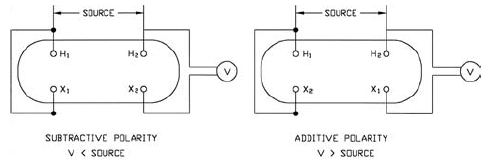
The polarity of a transformer can either be additive or subtractive. These terms describe the voltage that may appear on adjacent terminals if the remaining terminals are jumpered together.

The origin of the polarity concept is obscure, but apparently, early transformers having lower primary voltages and smaller kVA sizes were first built with additive polarity. When the range of kVAs and voltages was extended, a decision was made to switch to subtractive polarity so that voltages between adjacent bushings could never be higher than the primary voltage already present.

Thus the transformers built to ANSI standards today are additive if the voltage is 8660 or below and the kVA is 200 or less; otherwise they are subtractive.

This differentiation is strictly a U.S. phenomenon. Distribution transformers built to Canadian standards are all additive, and those built to Mexican standards are all subtractive. Although the technical definition of polarity involves the relative position of primary and secondary bushings, the position of primary bushings is always the same according to standards.

Therefore, when facing the secondary bushings of an additive transformer, the X1 bushing is located to the right (of X3), while for a subtractive transformer, X1 is farthest to the left.

To complicate this definition, a single-phase pad-mounted transformer built to ANSI standard Type 2 will always have the X2 mid-tap bushing on the lowest right-hand side of the lowvoltage slant pattern.

Polarity has nothing to do with the internal construction of the transformer windings but only with the routing of leads to the bushings. Polarity only becomes important when transformers are being paralleled or banked. Single-phase polarity is illustrated in Figure 2.2.11.


FIGURE 2.2.11 Single-phase polarity. (Adapted from IEEE C57.12.90-1999. The IEEE disclaims any responsibility or liability resulting from the placement and use in the described manner.

YΔ (WYE - DELTA) CLOSED / NEUTRAL = PRIM NO-SEC YES TRANSFORMER BANKING BASICS AND TUTORIALS

WYE - DELTA TRANSFORMER BANKING TUTORIALS
Wye - Delta Primary No Secondary Yes Banking Tutorials

WHERE USED
For supplying three-phase, 240 VAC loads with small amounts of 120/240 VAC, single-phase loads. No excessive circulating currents when transformers of unequal impedance and ratio are banked. No problem from third harmonic overvoltage or telephone interference.


WYE-DELTA FOR LIGHT & POWER
This diagram shows the connections for the Y-Delta bank to supply both light and power. This connection is similar to the delta-delta bank with only the primary connections changed. The primary neutral should not be grounded or tied into the system neutral, since a single-phase ground fault may result in extensive blowing of fuses throughout the system. The single-phase load reduces the available three-phase capacity. This connection requires special watt-hour metering.


BANK RATING
The transformer with the midtap carries 2/3 of the 120/240-volt, single-phase load and 1/3 of the 240-volt, three-phase load. The other two units each carry 1/3 of both the 120/240 and 240-volt loads.

CAUTION
The secondary neutral bushing can be grounded only on one of the three transformers.

IMPEDANCE & GROUNDING
The wye-delta connection is one of the most popular connections used today. Transformers are often connected from delta-delta to wye-delta to take advantage of 1.732 times the delta transmission voltage.

In this connection, it is not necessary that the impedance of the three transformers be the same. This connection should not be used with CSP single-phase transformers since when one breaker opens; serious unbalanced secondary voltages may appear.

The wye of this system should not be grounded because then the bank serves as a grounding bank and will supply ground-fault current for a phase-to-ground fault on the primary system. Also for unbalanced three phase loads on the primary system, the secondary acts as a balance coil; therefore, circulating current may result in an overload.

STATIC DISCHARGE
Potentially present on a non-grounded primary wye connection. A high, excessive voltage results on a 3 phase Y-Δ connection on the secondary line to ground when one leg of the primary is open. The voltage present is static with no power and bleeds off when taken to ground.

This static can damage a volt-ohm meter. The static is greater when the secondary feeder is short and lesser when the secondary feeder is long. The static problem is resolved by grounding one phase or the center tap of one transformer on the secondary side, but this usually requires special KWH metering.

This static condition is present only when a primary line is open, not the secondary. This static condition can occur on an open (2-transformers) or closed (3-transformers) bank. This static condition can occur with any primary voltage.

2400 VOLTS (2.4 kV) SYSTEM AND TRANSFORMERS BASIC AND TUTORIALS

DISTRIBUTION TRANSFORMER IN THE 2.4 kV SYSTEM TUTORIALS
A Tutorial On The 2.4 kV System and Its Distribution Transformers


In any particular voltage class, the actual rated voltage of a transformer has increased in years past. For example, the 2400-volt class of transformers formerly were rated 2200-110/220, then later they were rated 2300 115/230 and today they are rated 2400-120/240 volts.

This gradual increase in the rated voltage of transformers also occurred in the other voltage classes. Throughout the following material, we will speak of a particular voltage class by using present day rated voltage terminology.


In the early days of urban-electrical distribution, practically all systems were 2400-volt class, delta systems, and the 2400-volt transformer was designed and manufactured for this system. The selection of 2400 volt for distribution was logical from the standpoint of service and economy.

This voltage is high enough to give good system performance on systems where the distribution circuits are not very long. In addition, the voltage is sufficiently low to result in economical distribution equipment.

In recent years most 2400-volt delta systems have been changed over to 2400/4160Y-volt systems. This change was due to the fact that as the 2400-volt delta systems became more heavily loaded it became necessary to put in larger distribution-line conductors or raise the operating voltage in order to maintain proper voltage regulation.

The most economical procedure in this case was to raise the operating voltage to 4160Y, and this was economical because the change did not necessitate a change in transformers or other equipment on the line.

2400/4160-volt distribution systems are used in most urban areas throughout the country. Another factor that has contributed to the change from delta to Y systems is surge protection.

The three-phase four-wire solidly grounded Y system affords good grounds for surge arresters, and therefore, this system is superior from the standpoint of surge protection.

WYE-DELTA CLOSED THREE (3) PHASE BANKING OF SINGLE PHASE TRANSFORMER TUTORIALS

WYE - DELTA CLOSED TRANSFORMER BANKING TUTORIALS
A Tutorial On Transformer Banking (Wye -  Delta Closed)


WYE-DELTA CLOSED
YΔ CLOSED / NEUTRAL = PRIM NO-SEC NO


DIAGRAM


WHERE USED
To supply three-phase loads. No excessive circulating currents when transformers of unequal impedance and ratio are banked. No problem from third harmonic over-voltage or telephone interference. If a ground is required, it may be placed on either an X1 or an X2 bushing as shown.


WYE-DELTA FOR POWER
Often it is desirable to increase the voltage of a circuit from 2400 to 4160 volts to increase its potential capacity. This diagram shows such a system after it has been changed to 4160 volts. The previously delta-connected distribution transformer primaries are now connected from line to neutral so that no major change in equipment is necessary. The primary neutral should not be grounded or tied into the system neutral since a single-phase ground fault may result in extensive blowing of fuses throughout the system.


BANK RATING
Maximum safe bank rating for balanced three-phase loads (when transformer kva's are unequal) is three times the kva of the smallest unit. A disabled transformer renders the bank inoperative.


IMPEDANCE & GROUNDING
The wye-delta connection is one of the most popular connections used today. Transformers are often connected from delta-delta to wye-delta to take advantage of 1.732 times the delta transmission voltage.
In this connection, it is not necessary that the impedance of the three transformers be the same.
This connection should not be used with CSP single-phase transformers since when one breaker opens serious unbalanced secondary voltages may appear.

The wye of this system should not be grounded because then the bank serves as a grounding bank and will supply ground-fault current for a phase-to-ground fault on the primary system. Also for unbalanced three-phase loads on the primary system, the secondary acts as a balance coil; therefore, circulating current may result in an overload.


STATIC DISCHARGE
Potentially present on a non-grounded primary wye connection. A high, excessive voltage results on a 3-phase Y-Δ connection on the secondary line to ground when one leg of the primary is open. The voltage present is static with no power and bleeds off when taken to ground. This static can damage a volt-ohm meter.

The static is greater when the secondary feeder is short and lesser when the secondary feeder is long. The static problem is resolved by grounding one phase or the center tap of one transformer on the secondary side, but this usually requires special KWH metering. This static condition is present only when a primary line is open, not the secondary. This static condition can occur on an open (2-transformers) or closed (3-transformers) bank. This static condition can occur with any primary voltage.

FERRORESONANCE
Negative effects of ferroresonance are potentially present on non-grounded primary wye connections. There is more danger at 14,400/24.900 VAC and higher. There is more danger with smaller transformers.


A rule-of-thumb concerning negative ferroresonance effects is that transformers 25 KVA and smaller at 14,400/24,900 are susceptible to damage. 30 KVA and larger transformers are relatively safe from adverse ferroresonance effects at 14,400/24,900. Higher voltages than 14,400/24,900 would necessitate larger transformers than 30 KVA to be considered inherently safe from adverse ferroresonance effects.

On a floating Y-Δ connection, temporarily ground the primary neutral when closing or opening primary fuses to avoid adverse ferroresonance effects. A “chain ground” (a fourth or neutral cutout) should be installed and closed while closing or opening the power cutouts and then re-opened after all of the power cutouts are closed.

Configurations used to avoid ferroresonance are an open Y-Δ with a solidly grounded primary Y or a Y-Y with a solidly grounded primary and secondary Y connection.

Previous Articles